
Description
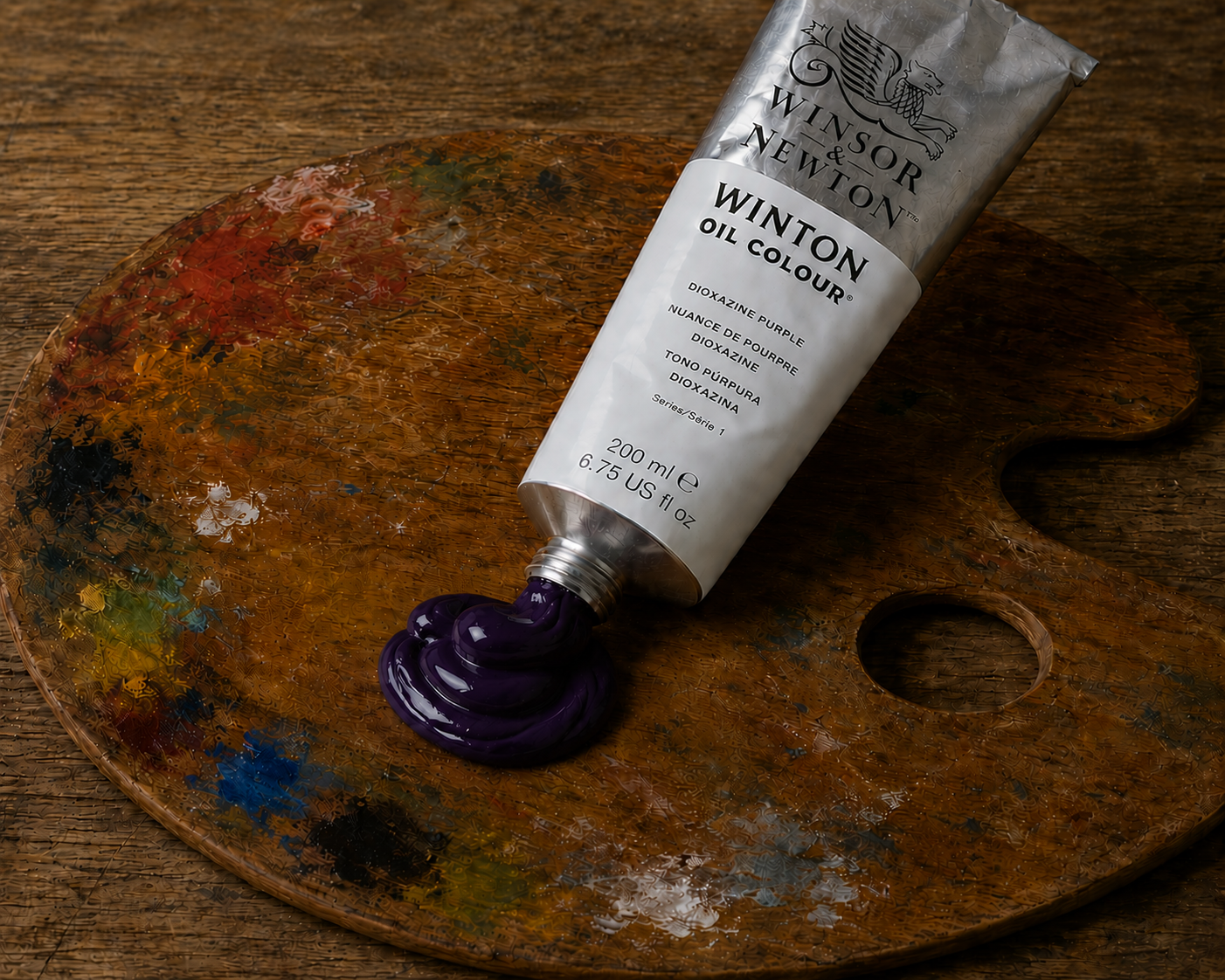
WINSOR & NEWTON’S WINTON MOODY DIOXAZINE PURPLE, 200ML
A deep, intense, and rich purple with high tinting strength and excellent transparency. This powerful, almost mysterious violet is perfect for dramatic shadows, night scenes, deep florals, and expressive abstract work. A fantastic glazing colour that adds richness and depth to any palette.
Undiluted, Dioxazine Purple reads as close to black — many painters use it in place of black entirely, for shadows and dark passages with far more richness than a flat, neutral black can offer. Thinned out, it opens up into a wide, luminous range of violets, from deep aubergine through to soft lavender, depending on how much medium you add.
This colour has strong tinting strength, so a small amount goes a long way when mixed into other colours. Its transparency makes it excellent for glazing — building up thin, luminous layers over an existing underpainting to shift the mood or deepen a shadow without flattening what’s beneath it.
Dioxazine Purple also plays well with cooler blues like Cerulean or Prussian to create deep, atmospheric night-sky tones, or with a touch of Yellow Ochre to mute it into a soft, dusty plum — useful for shadow work in warmer-toned paintings where a pure violet would feel too cold.
Pair it with Titanium White for bold, opaque violet tints, or mix it with warm reds and blues to explore a wide range of purples and dark, moody tones. It also works beautifully alongside Cadmium Deep Red Hue for deep, dramatic reds with a violet undertone.
The History of Dioxazine Purple
Purple has held a rare, expensive place in art history for centuries, going back to the natural dye Tyrian purple, once so costly it was reserved for royalty. Dioxazine Purple’s own story starts later, with the discovery of coal tar dyes in the mid-1800s, which opened the door to a wide range of new synthetic colours.
The specific pigment behind Dioxazine Purple, derived from a coal tar compound called carbazole, was developed by researchers in Germany and patented in 1928. It reached the market in the early 1950s under the name Permanent Violet RL, valued for its strength, lightfastness, and stability — qualities many earlier purples lacked.
Dioxazine Purple became a favourite of the Impressionists’ successors and beyond. The Impressionists themselves had already broken from tradition by painting shadows in colour rather than grey or black, with Monet declaring that fresh air itself was violet. Georgia O’Keeffe later used related violet pigments to build the rich, velvety depth seen in her botanical paintings. Today, Dioxazine Purple remains one of the most widely used violet pigments across painting, printing, and even industrial colour applications like car paint, thanks to its exceptional stability.
Winsor & Newton’s Winton range gives artists of all levels reliable colour and handling at an accessible price. It’s a solid choice whether you’re building your first palette or restocking a working studio.
Each 200ml tube offers generous coverage, and because this colour has such strong tinting power, it tends to last considerably longer than a similarly-sized tube of a less concentrated colour.
Dioxazine Purple Oil Paint — Storage and Handling
Store the tube upright with the cap tightly closed, away from direct heat, and it can last several months of regular painting. Squeeze out only what you need for a session — paint left exposed on the palette starts to skin over within a day, though this varies with humidity.
Because of its strong tinting strength, keep your brushes and palette knife clean between uses when working with this colour, as even a small residue can tint your next mix more than expected. Rinse thoroughly with solvent before switching to lighter colours.

Reviews
There are no reviews yet.